
Coloured lenses can relieve the symptoms of eye strain, visual perception and headaches in certain patients.
Precision tinted lenses can help patients with Visual Stress as well as others who have difficulty reading comfortably. The existence of visual stress and its treatment with coloured filters or lenses remains controversial due to a mixed body of evidence. Although visual factors are thought to contribute to some cases of reading difficulty, the relative contribution of visual stress and binocular instability compared to other factors (eg phonological deficit, verbal short-term/working memeory, rapid autonomised naming, magnocellular deficit) is poorly understood.Sometimes the problem of visual stress may run concurrently with other specific learning difficulties, but when visual stress is identified and treated, then any remaining difficulties associated with learning can be easier to deal with. Coloured lenses can relieve the symptoms of eye strain, visual perception and headaches in certain patients.
Migraines can have many triggers – stress, certain foods and hormones. About 40% of migraine attacks may be visually induced by flickering light, patterns or reading – these attacks may be helped by presicion tinted lenses. These lenses may also prevent migraine attacks and also allow patients to continue with their daily lives despite having an attack.
Dyslexia (usually diagnosed by an Educational Psychologist and not by an Optometrist) is an umbrella term for many sensory problems which affect learning – the main problem being the deficit of phonological skills. People with dyslexia have difficulty processing the sound structure of words. An Eye Care Practitioner can treat visual problems that can co-occur with dyslexia. Visual stress is NOT dyslexia but its symptoms are often confused with dyslexia as they result in poor reading. It is believed that around 20% of the dyslexic population may have Visual Stress and find coloured glasses helpful.
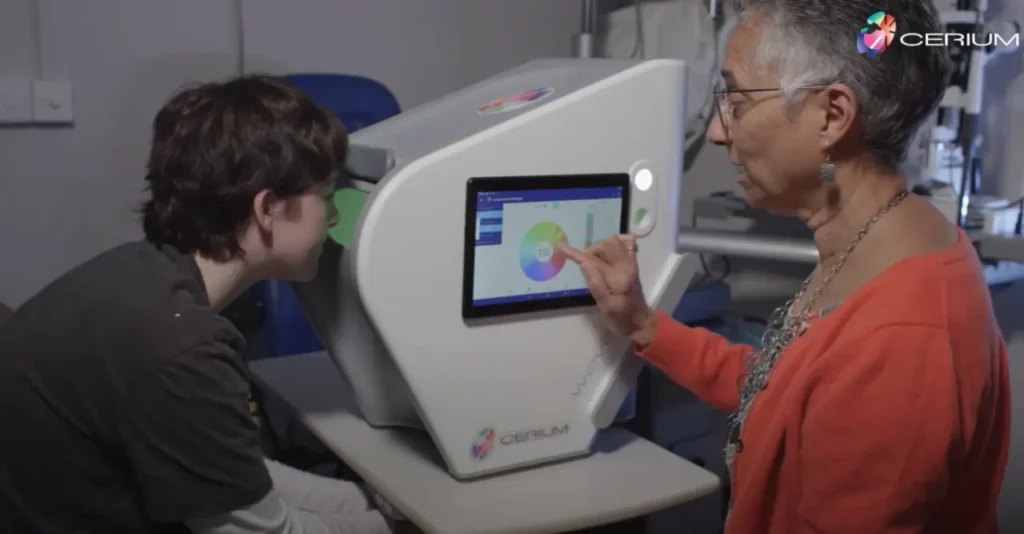
Precision tints can be applied to both prescription and non-prescription lenses and the tint is determined by using the Intuitive Colorimeter – a specialist instrument developed by Professor Arnold Wilkins.
If children have visual problems, treatment of these problems can help the child to read more comfortably and may improve their perception of text. This may help them to benefit from teaching and contribute to an improvement in reading performance. We may prescribe glasses in cases where a visual problem is present. Coloured glasses may alleviate visual stress.
The children most likely to benefit from colour will often show some of the following signs and symptoms:
It is advisable that patients (adults can suffer from the same problems as children) with these symptoms have a full examination to assess and deal with presenting problems. We will always discuss all our findings in full so that any additional testing can be agreed on together.
With regard to children we advise that you book an NHS eye test in the first instance, following which you will be advised further.
Though problems with sight are not usually the main cause of dyslexia, certain visual problems that occur more often in dyslexia may contribute to reading difficulty.
Though problems with sight are not usually the main cause of dyslexia, certain visual problems that occur more often in dyslexia may contribute to reading difficulty.
For more information or to book an assessment please call us on 020 8579 3241.
Lorem ipsum dolor sit amet, consectetur adipiscing elit


